Litany of the Most Blessed Sacrament: A Comprehensive Guide (Updated 04/01/2026)
Finding a Litany of the Most Blessed Sacrament PDF is readily achievable through reputable Catholic sources like EWTN and various Catholic websites, offering convenient access.
Numerous online platforms provide downloadable PDFs, facilitating personal and communal prayer with this powerful devotion.
Ensure the authenticity of the PDF by downloading from trusted sources to guarantee fidelity to the traditional prayers and avoid inaccurate versions.
What is the Litany of the Most Blessed Sacrament?
The Litany of the Most Blessed Sacrament is a solemn and extended prayer invoking various titles and attributes of Jesus Christ, particularly as present in the Eucharist.
It’s a powerful form of supplication, traditionally used in processions and during Eucharistic adoration, seeking divine mercy and grace through the Blessed Sacrament.
PDF versions allow for convenient personal or communal recitation, offering a portable and accessible means to engage with this profound spiritual practice.
These digital copies, often sourced from sites like EWTN, preserve the traditional structure and invocations, enabling faithful participation in this ancient devotion.
Historical Origins and Development
The Litany of the Most Blessed Sacrament’s origins trace back to medieval Europe, evolving from earlier litanies of the saints. Its development reflects a growing emphasis on Eucharistic devotion during that period.
Early forms were often associated with processions and public displays of the Blessed Sacrament.
PDF versions of the litany today represent a continuation of this historical practice, making the prayer accessible beyond traditional liturgical settings.
The standardization of the text occurred over centuries, with various revisions reflecting theological nuances and liturgical reforms, now preserved in digital formats.
Theological Significance of the Litany
The Litany of the Most Blessed Sacrament profoundly affirms core Catholic doctrines concerning the Real Presence of Christ in the Eucharist. Each invocation acknowledges Christ’s sacrifice and ongoing presence.
The litany’s structure emphasizes dependence on divine grace and mercy, central tenets of Catholic theology.
Accessing a PDF version facilitates deeper engagement with these theological truths, allowing for focused prayer and meditation on the mysteries of faith.
It’s a powerful expression of adoration, supplication, and thanksgiving, rooted in the belief of the Eucharist as the source and summit of Christian life.
Key Components and Structure
The Litany of the Most Blessed Sacrament follows a distinct call-and-response format, featuring a series of invocations addressing various aspects of Christ and the Eucharist.
These petitions are typically followed by the response “Kyrie eleison” (Lord, have mercy), emphasizing humility and reliance on God’s grace.
A readily available PDF version clearly displays this structure, aiding in both individual and communal recitation.
The litany progresses through themes of praise, supplication, and intercession, culminating in prayers for the Church and the world.
Invocation and Response Format
The Litany of the Most Blessed Sacrament is characterized by its distinct invocation and response structure, fostering a communal and participatory prayer experience.
Each invocation, a plea or title addressing God, is traditionally followed by the response “Kyrie eleison” (Lord, have mercy), or its variations.
A PDF version of the litany visually presents this pattern, simplifying participation for individuals and groups alike.
This rhythmic exchange encourages focused devotion and a unified expression of faith, deepening the spiritual impact of the prayer.
The Role of Petitioning in the Litany
The Litany of the Most Blessed Sacrament centers on heartfelt petitioning, humbly requesting divine grace and mercy through specific invocations.
These petitions encompass a wide range of needs – spiritual growth, forgiveness, protection, and the salvation of souls – all directed towards God’s loving compassion.
A readily available PDF version allows for focused prayer, guiding individuals through the structured requests and fostering a deeper connection with the divine.
This act of supplication acknowledges God’s power and our dependence on His grace, strengthening our faith and hope.
Traditional Latin Text and English Translations
The Litany of the Most Blessed Sacrament originates in the traditional Latin text, a cornerstone of Catholic devotion for centuries.
Numerous English translations exist, aiming to convey the original’s profound meaning and beauty while remaining accessible to modern worshippers.
A PDF version often presents both the Latin and English side-by-side, facilitating comparative study and deeper understanding of the invocations.
These translations strive for accuracy, preserving the litany’s theological richness and spiritual power for continued use in prayer and liturgy.

Comparing Different English Versions
Several English translations of the Litany of the Most Blessed Sacrament are available, each with subtle variations in wording and emphasis.
A PDF compilation showcasing these versions allows for direct comparison, revealing nuances in phrasing and theological interpretation.
Some prioritize literal accuracy, while others focus on poetic flow and contemporary language, impacting the overall prayer experience.
Examining these differences enhances appreciation for the litany’s depth and allows individuals to choose a version resonating with their spiritual sensibilities.
Accuracy and Nuance in Translation
When accessing a Litany of the Most Blessed Sacrament PDF, consider the translation’s fidelity to the original Latin text.
Precise translations preserve the theological weight of each invocation, ensuring doctrinal soundness and avoiding misinterpretations.
Nuance is crucial; certain words carry layered meanings, and a skilled translator captures these subtleties.
Comparing multiple PDF versions reveals variations in how these nuances are rendered, impacting the prayer’s spiritual impact and devotional richness.
Usage in Catholic Liturgy and Devotion
A Litany of the Most Blessed Sacrament PDF serves as a valuable resource for both liturgical settings and personal devotion.
Historically, it’s been employed during Eucharistic processions and services, enhancing communal prayer and reverence for the Eucharist.
Individuals utilize PDF versions for private prayer, Eucharistic Adoration, and spiritual reflection, deepening their connection with Christ.
The litany’s structure facilitates focused petitioning and heartfelt supplication, fostering a profound sense of faith and devotion within the Catholic tradition.
Public Recitation and Processions
A readily available Litany of the Most Blessed Sacrament PDF greatly facilitates its use in public settings, particularly during processions.
Historically, the litany has been a central component of Eucharistic processions, chanted or recited by the congregation as the Blessed Sacrament is carried.
Having a PDF version ensures uniformity in the prayers recited, allowing for a more unified and reverent experience for all participants.
Parishes often utilize these PDFs for training altar servers and choir members, ensuring a smooth and spiritually enriching public devotion.
Private Prayer and Personal Devotion
The convenience of a Litany of the Most Blessed Sacrament PDF makes it an ideal resource for deepening one’s personal prayer life.
Individuals can easily download and print the PDF for use during private adoration, meditation, or as a daily devotional practice.
Its accessibility allows for consistent recitation, fostering a closer relationship with Christ in the Eucharist.
Many find the structured format of the litany helpful in focusing their intentions and offering heartfelt petitions, enhancing their spiritual growth.
The Litany and Eucharistic Adoration
A Litany of the Most Blessed Sacrament PDF is an invaluable companion during Eucharistic Adoration, enriching the experience of prayer before the Blessed Sacrament.
Having a readily available PDF allows adorers to seamlessly incorporate the litany into their holy hour, offering a structured and profound form of devotion.
The litany’s petitions beautifully complement the silence and contemplation of adoration, drawing the worshiper closer to Christ’s Real Presence.
It provides a powerful means of expressing reverence, gratitude, and supplication before the Eucharistic Lord.
Connecting the Litany to the Real Presence
Utilizing a Litany of the Most Blessed Sacrament PDF profoundly deepens one’s understanding and appreciation of the Real Presence of Christ in the Eucharist.
The litany’s invocations directly address and honor the Eucharistic Lord, acknowledging His Body, Blood, Soul, and Divinity present in the Blessed Sacrament.
A conveniently accessible PDF facilitates frequent recitation, reinforcing the belief in the transformative power of the Eucharist.
Each petition serves as an act of faith, affirming the mystery and majesty of Christ’s gift to humanity.
Enhancing Adoration with the Litany
Employing a Litany of the Most Blessed Sacrament PDF during Eucharistic Adoration significantly enriches the experience, fostering a deeper connection with Christ.
The litany’s structured prayers provide a framework for focused devotion, guiding the worshiper through heartfelt petitions and expressions of love.
Having a readily available PDF allows for seamless integration into adoration, eliminating distractions and promoting contemplative prayer.
The rhythmic recitation enhances spiritual focus, drawing the heart closer to the Real Presence in the Blessed Sacrament.
Benefits of Praying the Litany
Utilizing a Litany of the Most Blessed Sacrament PDF unlocks numerous spiritual benefits, deepening one’s faith and relationship with God.
The litany’s petitions invoke divine mercy, seeking protection and grace for oneself and others, readily accessible through a downloaded PDF.
Consistent prayer fosters spiritual growth, cultivating humility, gratitude, and a stronger desire for holiness.
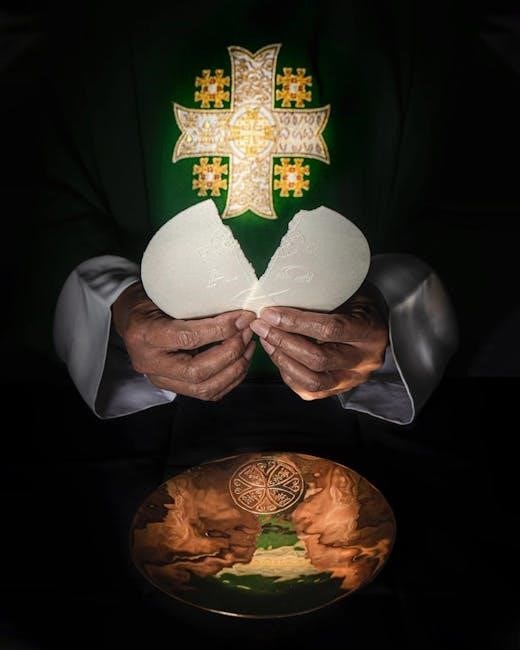
The structured format aids concentration, while the powerful invocations strengthen devotion to the Eucharist and its transformative power.
Spiritual Growth and Grace
Accessing a Litany of the Most Blessed Sacrament PDF facilitates profound spiritual growth through consistent, focused prayer.
The litany’s repetitive invocations, easily obtained via PDF download, cultivate a meditative state, drawing one closer to God’s presence.
Regular recitation fosters humility and a deeper understanding of the Eucharist’s sacredness.
Praying the litany invites divine grace, strengthening faith, hope, and charity, leading to a more virtuous and fulfilling life centered on Christ.
Seeking Divine Mercy and Protection
Utilizing a Litany of the Most Blessed Sacrament PDF provides a powerful avenue for imploring divine mercy and seeking God’s protective grace.
The litany’s petitions, readily available in PDF format, acknowledge human weakness and dependence on God’s loving-kindness.
Through fervent prayer, individuals can request forgiveness, healing, and deliverance from spiritual and temporal harm.
The litany serves as a shield against evil, offering solace and strength in times of trouble, fostering trust in God’s unwavering care.
Finding a Litany of the Most Blessed Sacrament PDF
Locating a Litany of the Most Blessed Sacrament PDF is straightforward, with numerous resources available online. EWTN, a highly reputable Catholic source, offers a readily accessible PDF version for download.
Various other Catholic websites also provide this devotional prayer in PDF format, catering to individual and communal prayer needs.
These digital copies allow for convenient printing and use during personal devotion, Eucharistic adoration, or liturgical celebrations.
Reputable Sources for PDF Downloads (EWTN, Catholic Websites)

When seeking a Litany of the Most Blessed Sacrament PDF, prioritize trusted sources to ensure accuracy and authenticity. EWTN (ewtn.co.uk) stands as a premier resource, offering a reliable and easily downloadable version.
Beyond EWTN, numerous established Catholic websites provide the litany in PDF format, including those affiliated with dioceses and religious orders.
Always verify the source’s credibility before downloading to safeguard against potentially inaccurate or altered versions of this cherished prayer.
Ensuring Authenticity of the PDF
To guarantee the Litany of the Most Blessed Sacrament PDF you obtain is genuine, cross-reference it with known, reliable versions from sources like EWTN. Compare the invocations and responses carefully.
Look for PDFs originating from established Catholic organizations or diocesan websites, as these are less likely to contain errors or alterations.
Be wary of downloads from unfamiliar or unverified sources, and always prioritize PDFs that closely match the traditional Latin text and approved English translations.
Variations and Adaptations of the Litany
While the core Litany of the Most Blessed Sacrament PDF remains consistent, variations exist to suit specific needs. Some adaptations include litanies for particular intentions, like healing or peace.
PDF versions may also present shortened or simplified forms for ease of recitation, especially for children or those new to the devotion.
However, ensure any adapted version retains the fundamental invocations honoring the Eucharist and its sacred mysteries, maintaining theological integrity.
Litany for Specific Intentions
Although the standard Litany of the Most Blessed Sacrament PDF is universally applicable, customized versions exist for focused prayer. These litanies incorporate additional invocations tailored to specific needs.
PDF resources may offer litanies for healing, spiritual growth, or petitions for the Church and the world. These adaptations supplement the core litany, enriching devotional practice.
When utilizing these, ensure they complement, rather than replace, the foundational reverence for the Eucharist expressed in the traditional form.

Shortened or Simplified Versions
Accessibility is key, and some Litany of the Most Blessed Sacrament PDF versions offer shortened or simplified formats. These are designed for ease of recitation, particularly for those new to the prayer or with limited time.
These condensed versions retain the core invocations while streamlining the overall length, making it practical for group settings or personal devotion.
However, it’s crucial to ensure these adaptations maintain the theological integrity and reverence inherent in the original, complete litany.
The Litany in Relation to Other Catholic Litanies
The Litany of the Most Blessed Sacrament PDF distinguishes itself from other Catholic litanies, like the Litany of Saints, through its singular focus on the Eucharist. While the Litany of Saints intercedes through holy figures, this litany directly petitions Christ through His presence in the Sacrament.
Both share a similar invocation-response structure, but the Blessed Sacrament Litany’s invocations center on attributes of Christ and the Eucharist, emphasizing adoration and thanksgiving.
Understanding this distinction highlights the unique spiritual depth of this particular devotion.
Comparison with the Litany of Saints
A Litany of the Most Blessed Sacrament PDF differs significantly from the Litany of Saints, despite sharing the invocation-response format. The Saints’ Litany petitions intercession through the saints, while this litany directly addresses Christ, present in the Eucharist.
The Blessed Sacrament Litany’s invocations focus on divine attributes and Eucharistic mysteries, fostering adoration. Conversely, the Litany of Saints calls upon specific saints for their unique patronage.
Both are powerful prayers, but serve distinct devotional purposes.
Unique Focus of the Blessed Sacrament Litany
A Litany of the Most Blessed Sacrament PDF distinguishes itself through its singular concentration on the Real Presence of Christ in the Eucharist. Unlike other litanies, it doesn’t petition saints for intercession, but directly implores divine mercy and adoration.
Its invocations center on Christ’s sacrificial love, the sacredness of the Eucharist, and the profound mysteries of the Holy Sacrifice of the Mass.
This focused devotion fosters a deeper connection with Christ’s body, blood, soul, and divinity.
Common Misconceptions About the Litany
A frequent misunderstanding regarding the Litany of the Most Blessed Sacrament PDF centers on the perceived repetitiveness of its invocations. Some believe this renders the prayer monotonous or lacking in spiritual depth.
However, this repetition is intentional, mirroring the persistent pleas of scripture and fostering a meditative state.
Another misconception is that the litany is solely for clergy; it’s a powerful devotion accessible and beneficial for all faithful Catholics seeking deeper Eucharistic reverence.
Addressing Concerns About Repetitive Prayer
Concerns about the repetitive nature of the Litany of the Most Blessed Sacrament PDF often arise, questioning its value as a form of prayer. This repetition isn’t aimless; it’s a deliberate practice rooted in biblical tradition, echoing persistent supplication.
The litany’s structure encourages meditative focus, allowing the mind to dwell on the profound mysteries of the Eucharist.
Repetition isn’t about rote recitation, but about entering a deeper state of prayerful contemplation and surrender to Divine Mercy.
Understanding the Purpose of Repetition
The repetition within the Litany of the Most Blessed Sacrament PDF serves a crucial spiritual purpose, mirroring the persistent pleas found throughout Scripture. It’s not merely a formulaic exercise, but a method to deepen our focus and humble our hearts before God.
This rhythmic invocation allows for meditative absorption, fostering a profound connection with the Real Presence.
Repetition aids in overcoming distractions, leading to a more fervent and focused prayer life, ultimately drawing us closer to Divine Grace.
Resources for Further Study
Delving deeper into the Litany of the Most Blessed Sacrament PDF requires exploring supplementary materials. Numerous books detail its history and theological significance, enriching understanding.
Websites like EWTN offer insightful articles and explanations, providing context for the litany’s prayers.
Academic journals and theological publications further illuminate its origins and impact on Catholic devotion, aiding comprehensive study and appreciation of this powerful prayer.
Books and Articles on the Litany
Exploring the Litany of the Most Blessed Sacrament PDF is enhanced by dedicated scholarly works. While specific titles focusing solely on the litany are limited, broader books on Catholic liturgy and Eucharistic devotion often include sections detailing its history;
Articles in theological journals may analyze its development and spiritual impact.
Searching online databases and Catholic publishing houses can reveal relevant resources, providing deeper insight into this cherished devotional practice and its PDF availability.
Online Resources and Websites
Numerous websites offer the Litany of the Most Blessed Sacrament PDF for download and use. EWTN, a trusted Catholic resource, provides a readily accessible version on their website (ewtn.co.uk).
Various Catholic parishes and devotional sites also host PDFs, facilitating convenient access for personal or group prayer.
Always verify the source’s credibility to ensure the PDF reflects the authentic, traditional text of this powerful and beloved litany.
Printing and Formatting a Litany PDF
When printing a Litany of the Most Blessed Sacrament PDF, consider optimal formatting for readability. A font size of 12-14 points is generally recommended, alongside a clear, traditional typeface.
Layout should prioritize spaciousness, avoiding cramped text. High-quality paper, such as 24lb weight, enhances the prayer experience.
Simple binding options, like saddle-stitch or coil binding, create a durable and aesthetically pleasing booklet for frequent use during devotion and prayer.
Optimal Font Size and Layout
For a Litany of the Most Blessed Sacrament PDF, selecting an optimal font size and layout is crucial for comfortable reading during prayer. A font size between 12 and 14 points generally provides excellent clarity for most users.
Traditional fonts like Times New Roman or Garamond are often preferred for their readability and reverence.
Ensure sufficient margins and line spacing to prevent a cluttered appearance, fostering a more focused and prayerful experience when utilizing the printed Litany.
Paper Quality and Binding Options
When printing a Litany of the Most Blessed Sacrament PDF, the paper quality significantly impacts the overall experience. A weight of 24lb or higher is recommended for durability and a premium feel.
For frequent use, consider a thicker cardstock cover to protect the pages.
Binding options range from simple saddle-stitch stapling for shorter versions to more durable coil or perfect binding for longer, frequently used Litany booklets, enhancing longevity.
The Litany and Marian Devotion
While the Litany of the Most Blessed Sacrament PDF primarily focuses on Eucharistic devotion, incorporating Marian invocations is a common and enriching practice.
Many versions include petitions to Mary, Mother of God, acknowledging her vital role in receiving Christ and interceding for believers.
This blending highlights the inseparable connection between the Eucharist and Marian devotion, recognizing Mary’s profound relationship with the Blessed Sacrament.
Incorporating Marian Invocations
When utilizing a Litany of the Most Blessed Sacrament PDF, adding Marian invocations enriches the prayer experience, acknowledging Mary’s unique role.
Common additions include “Pray for us, Holy Mother of God,” or specific titles like “Immaculate Heart of Mary, pray for us.”
These petitions recognize Mary’s intercession and her maternal connection to Jesus, the source and summit of the Eucharistic mystery, deepening devotion.
The Blessed Sacrament and Mary’s Role
A Litany of the Most Blessed Sacrament PDF highlights the inseparable connection between the Eucharist and Mary, the Mother of God.
Mary’s fiat brought Christ into the world, making her intrinsically linked to the Incarnation and, therefore, the Eucharist – Christ’s Body and Blood.
Her presence at the foot of the Cross and her spiritual motherhood extend to the Eucharist, offering a profound model of receptive love and contemplation.
Future of the Litany in Modern Catholicism
Accessing a Litany of the Most Blessed Sacrament PDF demonstrates its enduring relevance in contemporary Catholic practice.
Despite evolving liturgical norms, the Litany’s power to deepen Eucharistic devotion ensures its continued place in personal and communal prayer.
Promoting wider availability of PDFs and encouraging its recitation, particularly during Eucharistic adoration, will foster renewed appreciation for this spiritual treasure among future generations.
Continued Relevance in a Changing World
The accessibility of a Litany of the Most Blessed Sacrament PDF underscores its timeless appeal in a rapidly changing world.
In an era of increasing secularization, this devotion offers a powerful anchor in faith, deepening connection with the Real Presence.
Providing easily downloadable PDFs allows individuals to integrate this ancient prayer into their daily lives, fostering spiritual resilience and a renewed sense of the sacred amidst modern challenges.
Promoting the Litany for Future Generations
Widespread availability of the Litany of the Most Blessed Sacrament PDF is crucial for introducing this devotion to younger Catholics.
Digital accessibility ensures the prayer remains relevant, bypassing barriers of traditional formats and reaching a tech-savvy audience.
Encouraging its use in parishes, schools, and online communities will cultivate a deeper Eucharistic spirituality, safeguarding this treasured practice for generations to come, fostering faith and devotion.